SKYTHO

Loading… 0%

SKYTHOAutonomous first-aid drone

The drone that reaches you before the rescuers do.

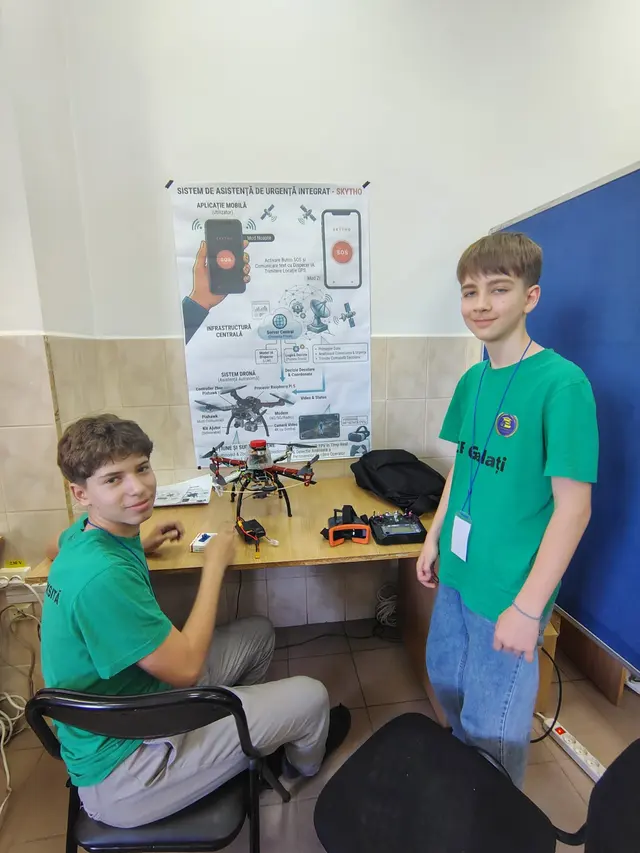
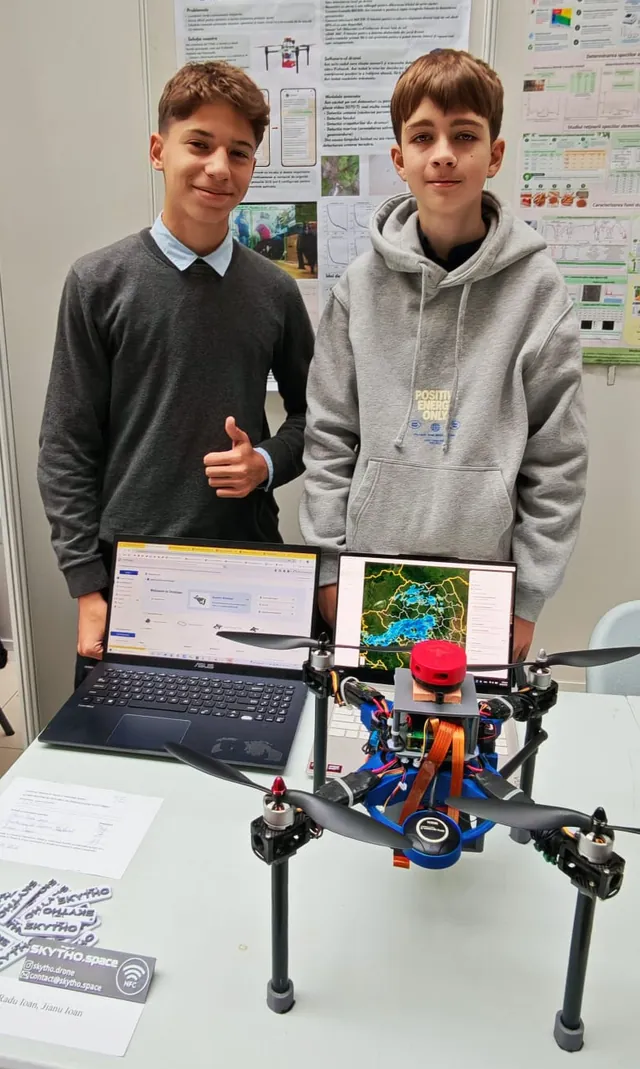
You get hurt in the mountains and press SOS. SKYTHO, an autonomous SAR drone built by students from Galați, Romania, sets off towards you with a first-aid kit.

1st Prize
RoSEF 2026, Suceava
2nd Prize
Romanian National Scientific Creativity Olympiad 2026
Built by
Radu and Dorin8th grade

Scroll

The SKYTHO drone

In the mountains, an injury doesn't wait. Rescuers climb on foot, sometimes for hours. Until they arrive, you are on your own.

Chapter 1

Six moments, from the button you press to the kit dropped next to you.

  1. 01SOSYou press the button. Your phone sends your GPS location and your medical profile.
  2. 02TriageAMI finds out what happened; an operator reads the conversation.
  3. 03Take-offThe mission heads for your coordinates.
  4. 04The flightThe drone flies itself and steers around obstacles.
  5. 05DetectionThe camera and on-board AI find you from the air.
  6. 06DeliveryThe kit lands next to you; rescuers get your exact location.

00:00from SOS to first-aid kit

01

You press SOS.

One press. Your phone sends your GPS location and your medical profile: allergies, conditions, medication and emergency contacts. If you pressed by mistake, you have a few seconds to cancel.

02

AMI messages you right away.

Our AI assistant asks what happened and tells you, step by step, what to do until the drone arrives and how to use the kit. A human operator reads the conversation live and can take it over at any time.

03

The mission starts.

AMI judges how serious the injury is and sends the drone its mission, with your coordinates. The operator follows it live in SKYTHO Hub: the camera feed, the map, the battery and the LiDAR.

04

The drone flies itself.

It flies with no pilot, over the forest, along the route worked out to reach you. The Pixhawk flight controller keeps it steady in the wind, the GPS takes it to your coordinates and the 360° LiDAR sees the trees and rocks around it.

05

It finds you from above.

The front camera films the ground, and a YOLOv8 model we trained, running on the Hailo-8 accelerator, recognises a person from the air. It all happens on the drone, with no internet.

06

The kit lands next to you.

The drone comes down above you, a servo pulls the pin and the kit drops a step away: sterile dressings, an elastic bandage and a thermal blanket. The rescuers get your exact location.

Chapter 2

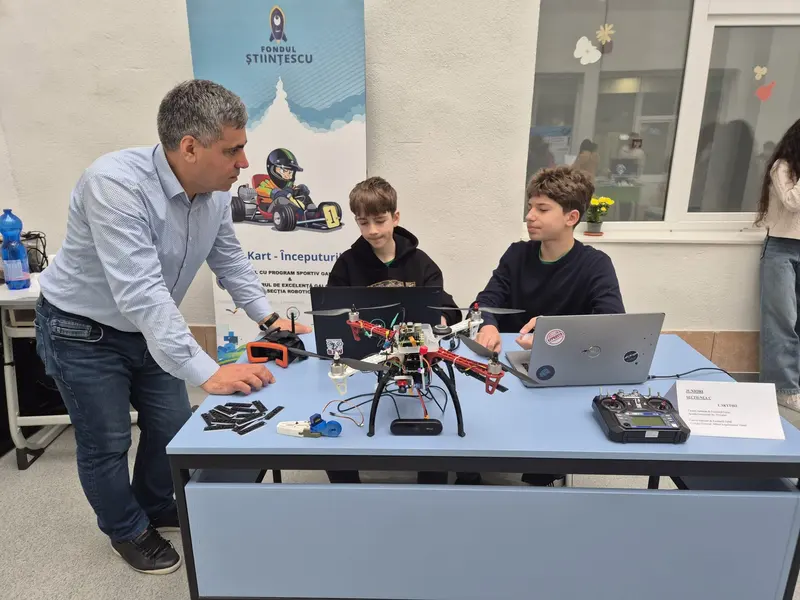
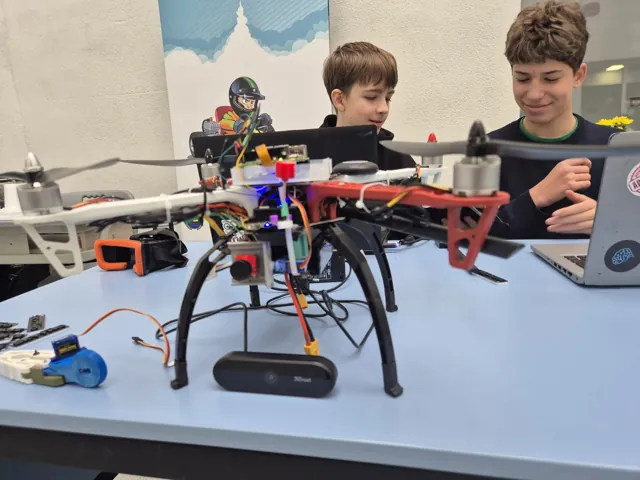
Built by us, part by part. We designed and 3D-printed the frame, trained the AI models and calibrated every sensor.

01The brain

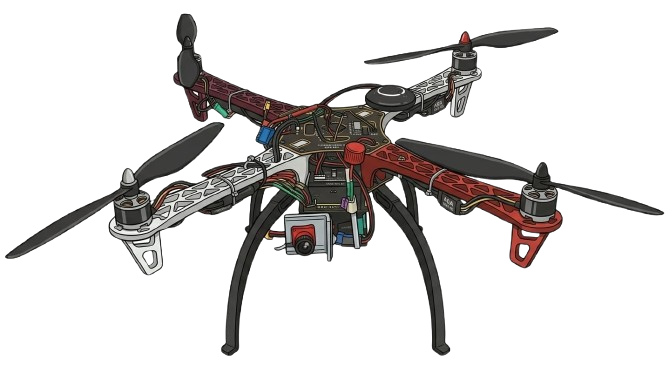
Raspberry Pi 5, Hailo-8 and Pixhawk 2.4.8

The Raspberry Pi 5 reads the sensors and processes the images, and the Hailo-8 accelerator runs the AI detection. The Pixhawk 2.4.8 is the flight controller: it keeps the drone stable and carries out the commands it receives over MAVLink.

  • Raspberry Pi 5: four Cortex-A76 cores at 2.4 GHz
  • Hailo-8: up to 26 TOPS for neural networks
  • Pixhawk 2.4.8: gyroscope, accelerometer, barometer

02The eyes

Sony IMX500 and IMX219 cameras

The front IMX500 camera films the ground for person detection. The downward-facing IMX219 camera tracks how the drone moves over the ground (optical flow), so it can hold its position even without GPS.

  • IMX500: 12.3 MP, with on-sensor AI processing
  • IMX219: 8 MP, for optical flow
  • Live video to the operator

03The senses

360° LiDAR and a ToF sensor

The LiDAR spins and measures, point by point, the distance to everything around the drone: that's how it sees trees and rocks. The downward-facing ToF sensor measures the exact height above the ground.

  • A 360° scan on every turn
  • Distances in 8 directions, for avoiding obstacles
  • ToF: the height for take-off and landing

04Propulsion and frame

4 brushless motors on carbon tubes

Brushless outrunner motors on carbon-tube arms held in a modular 3D-printed frame. The Pixhawk adjusts their speed hundreds of times a second through the ESCs.

  • Propellers of about 10 inches: two CW, two CCW
  • Carbon-tube arms and legs
  • 3D-printed frame, easy to repair

05Navigation

M8N GPS with compass

The M8N GPS module listens to several satellite constellations and the compass gives it its heading. The Pixhawk uses the position to take the drone exactly to the coordinates sent from the app.

  • GPS and GLONASS
  • Built-in compass
  • Without GPS: optical flow and ToF

06Power

6000 mAh battery

It powers the motors, the Raspberry Pi, the Pixhawk and the sensors. It sits in the middle of the drone to keep the weight balanced.

  • 6000 mAh
  • Mounted at the centre of gravity
  • Quick to swap between missions

07Payload

First-aid kit and servo

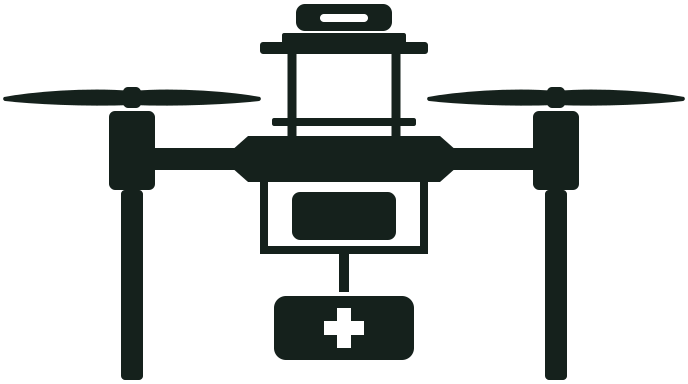
The kit is held under the drone by a pin. Above the person, a servo pulls the pin and the kit drops next to them. We designed the release mechanism ourselves.

  • Servo release
  • Sterile dressings, elastic bandage, thermal blanket
  • Lands a step away from the person

Chapter 3

The app, the server, the drone and the operator station are all built by us. Here is how each one works.

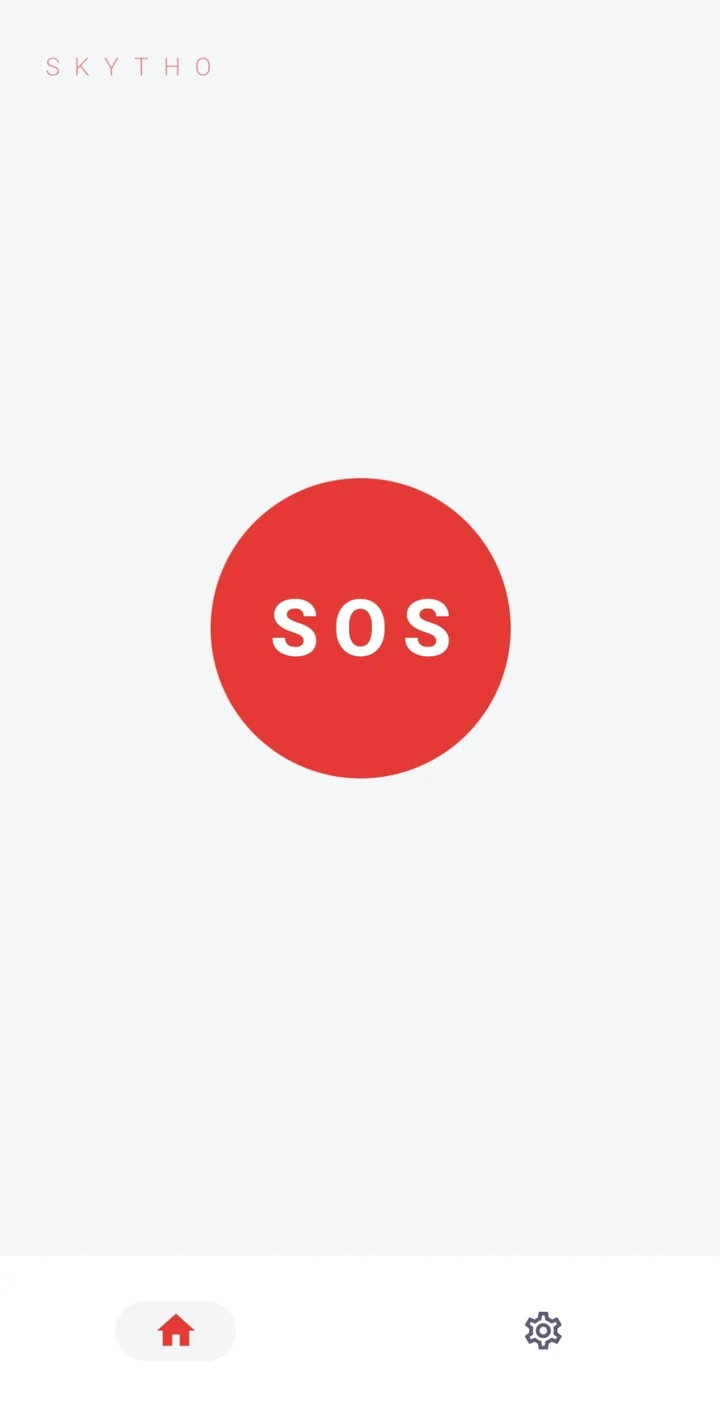
  1. The app

    One button.

    If something happens to you on the mountain, you open the app and press SOS.

  2. The app

    Three seconds to cancel.

    If you pressed it by mistake, you tap the number and nothing is sent.

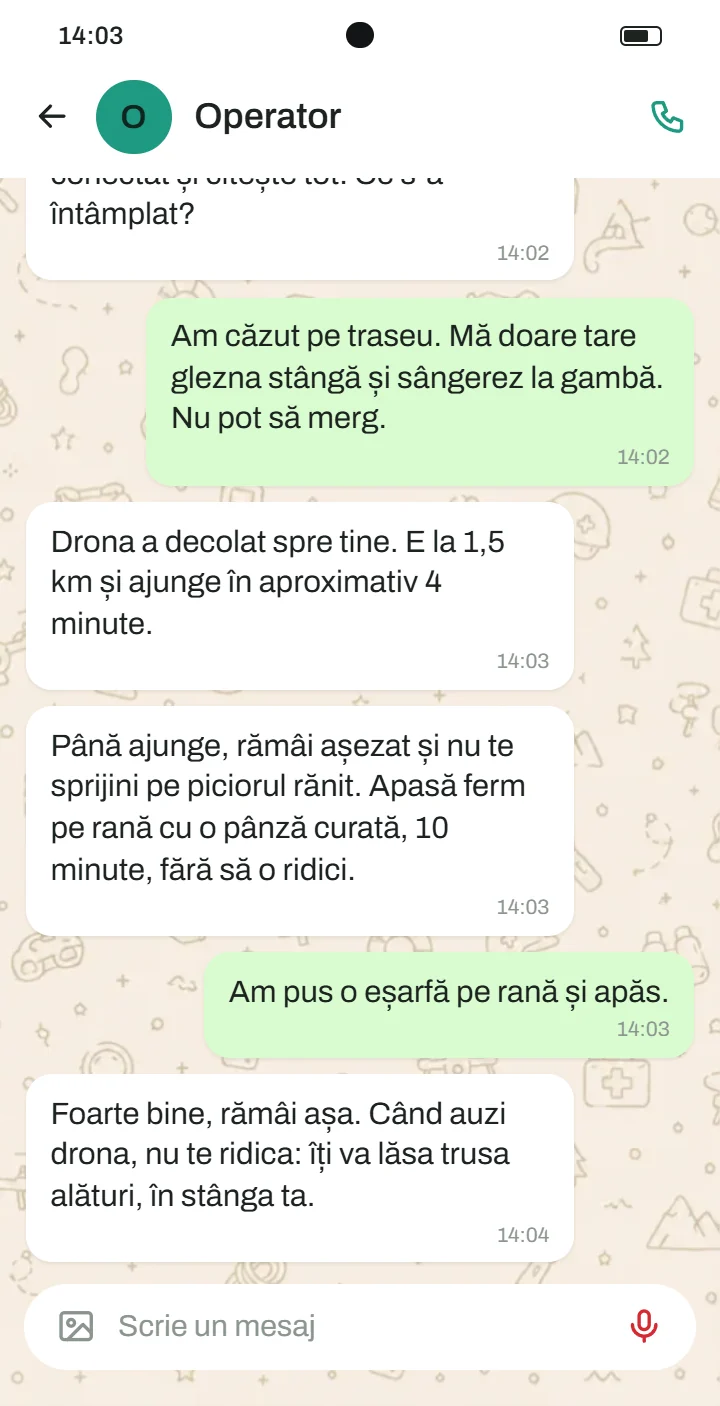
  3. The app

    Then you talk to AMI.

    Your GPS location and medical profile have already gone out. AMI asks what happened.

The SKYTHO app: the red SOS button The SKYTHO app: the conversation with AMI after an SOS (in Romanian)
  • Voice callYou talk to AMI out loud, no typing.
  • Send a photoShow the wound or the place you are in.
  • The microphoneSay your message out loud if you cannot type.

Written in Kotlin with Jetpack Compose, for Android 8 or newer.

Software

SOS app
Kotlin, Jetpack Compose, Android 8+
SKYTHO Hub
Tauri 2, Rust and Svelte
Server and AMI
Python, FastAPI, SQLite
Drone link
MAVLink over UDP, WebSocket relay
On-board pilot
Python on Raspberry Pi 5
Website
JavaScript, three.js, HTML, CSS

Next: a thermal camera, searching by phone signal, several drones in one mission.

Awards

Two national competitions in 2026, two prizes for SKYTHO.

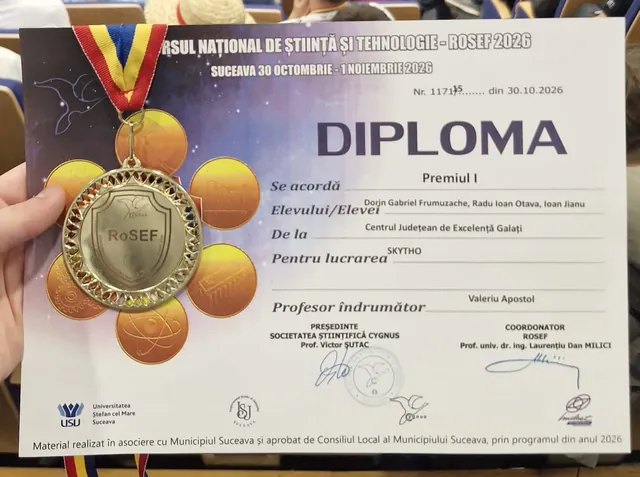
The 1st Prize diploma at RoSEF 2026 for the SKYTHO project, with the RoSEF medal

1st Prize

RoSEF 2026 – Romanian national science and technology competition

Suceava, 30 October – 1 November 2026. Organised by the Cygnus Scientific Society at the Ștefan cel Mare University of Suceava.

Frumuzache Dorin Gabriel, Otava Radu Ioan and Ioan Jianu, Galați County Centre of Excellence. Supervising teacher: Valeriu Apostol.

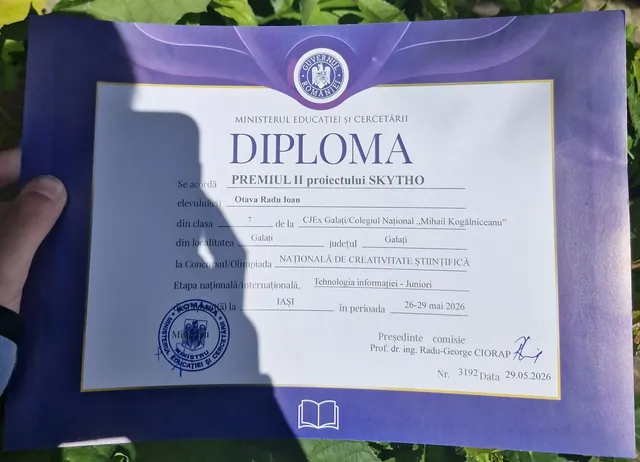
The 2nd Prize diploma for the SKYTHO project at the Romanian National Scientific Creativity Olympiad 2026

2nd Prize

Romanian National Scientific Creativity Olympiad 2026

National stage, Iași, 26–29 May 2026, Information Technology – Juniors. Organised by the Romanian Ministry of Education and Research.

Frumuzache Dorin Gabriel and Otava Radu Ioan, Galați County Centre of Excellence. Official list of prizes (PDF, in Romanian)

Team

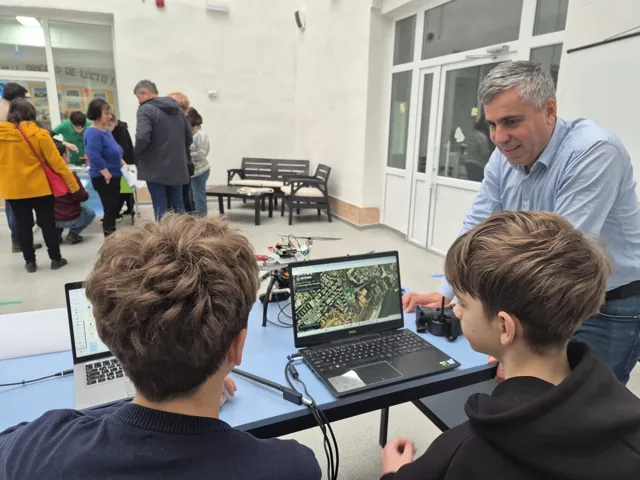
We are two 8th-grade students from Galați, Romania, working together at the Galați County Centre of Excellence (CEX Galați). We designed, calibrated and tested every part from scratch.

Logo of the Galați County Centre of Excellence Galați County Centre of Excellence (CEX)
Otava Radu Ioan
The SOS mobile app, the central server, the AMI AI dispatcher, the operator station, telemetry and the live map.
Middle School No. 28, Galați, 8th grade
Frumuzache Dorin
Hardware architecture, the flight controller, LiDAR calibration, YOLO model training, the 3D frame and the autonomous flight logic.
“Mihail Kogălniceanu” National College, Galați, 8th grade
Apostol Valeriu
Galați County Centre of Excellence.
Supervising teacher

Frequently asked questions

What SKYTHO is, how it works and how you can help, in short.

What is SKYTHO?

SKYTHO is an autonomous SAR (search and rescue) drone built by students at the Galați County Centre of Excellence in Romania. It receives an SOS from our app, flies by itself to the person's location, finds them with a camera and an AI model running on board, and drops a first-aid kit next to them. The project won 1st Prize at RoSEF 2026 and 2nd Prize at the Romanian National Scientific Creativity Olympiad 2026.

What is a SAR drone?

A SAR (search and rescue) drone looks for people who are lost or injured and helps them until rescuers arrive. SKYTHO does two things, separately or together: it searches for people with a camera and on-board AI and sends their position to the rescuers, and it quickly flies a first-aid kit to the coordinates sent from the app.

How does SKYTHO work?

You press SOS in the app and your phone sends your GPS location and medical profile. AMI, our AI assistant, finds out what happened and starts the mission, and an operator follows it in SKYTHO Hub. The drone flies with no pilot, sees obstacles with its LiDAR, recognises you from the air with a YOLOv8 model running on the Hailo-8 accelerator, comes down and releases the kit next to you.

What parts does the drone have?

A Pixhawk 2.4.8 flight controller, an M8N GPS with compass, a Raspberry Pi 5 with the Hailo-8 AI accelerator, Sony IMX500 (detection) and IMX219 (optical flow) cameras, a 360° LiDAR, a ToF sensor, 4 brushless motors, a 6000 mAh battery, a servo mechanism for the kit and a modular 3D-printed frame with carbon-tube arms and legs.

Does it need the internet?

Not for detection: the AI models run on the drone, on the Hailo-8 accelerator. Flight data reaches the operator station over MAVLink, and video and telemetry go through a WebSocket relay. A 4G/5G modem, for coverage in the mountains, is planned for the next version.

What's in the first-aid kit?

Sterile dressings, an elastic bandage and a thermal blanket. The kit is held under the drone by a pin. When the drone is above you, a servo pulls the pin and the kit drops a step away from you.

What prizes has SKYTHO won?

1st Prize at RoSEF 2026, the Romanian national science and technology competition (Suceava, 30 October – 1 November 2026), and 2nd Prize at the Romanian National Scientific Creativity Olympiad 2026 (Iași, 26–29 May 2026, Information Technology – Juniors).

Who built SKYTHO?

Otava Radu Ioan and Frumuzache Dorin, 8th-grade students from Galați, Romania, at the Galați County Centre of Excellence, with their supervising teacher Apostol Valeriu. At RoSEF 2026 the team also included Ioan Jianu.

How can I sponsor SKYTHO?

With its 1st Prize at RoSEF 2026, SKYTHO was invited to the Taiwan International Science Fair (TISF 2027) in Taipei, 23–30 January 2027. We are looking for sponsors, companies, institutions or individuals, to help us get there. See how you can support us.
How can we contact you?

By email at contact@skytho.space, or on Instagram at @skytho_drone.